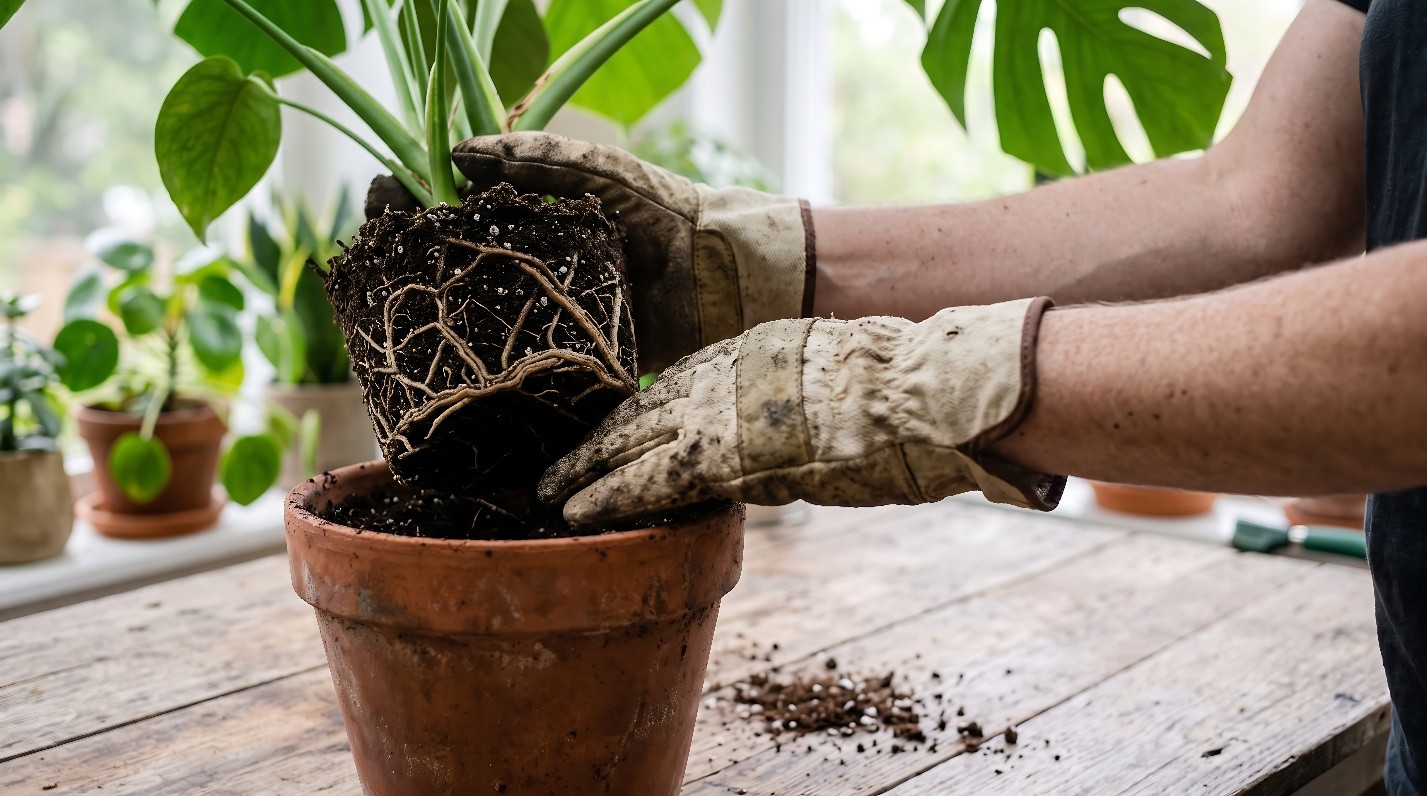
Repotting is a routine part of care for many houseplants and container-grown plants but knowing exactly when to do so can sometimes be difficult. A plant may look perfectly comfortable above the soil while its roots have already filled nearly every available inch of its container. On the other hand, a plant that has stopped growing does not necessarily need a bigger pot.
Rather than repotting according to a strict schedule, Saralyn Wasserman understands that plant owners can learn to recognize the physical signs that a plant is outgrowing its current home. Roots emerging from drainage holes, unusually fast-drying soil, slowed growth, and difficulty absorbing water can all indicate that a plant is becoming root-bound. Understanding what happens inside a crowded pot, and knowing how to respond, can make repotting a much simpler part of long-term plant care.
What Does It Mean for a Plant to Be Root-Bound?
As a healthy plant grows above the soil, its root system develops below the surface. Roots spread through the potting mix, absorbing the water and nutrients the plant needs. In a container, however, there is a limit to how far those roots can travel. Eventually, roots reach the sides and bottom of the pot. As they continue developing, they may begin circling around the inside of the container and become increasingly crowded. This condition is commonly referred to as being root-bound or pot-bound.
Being slightly root-bound does not necessarily mean that a plant is in immediate trouble. Some species tolerate crowded containers better than others and some plants prefer it. Problems become more likely when roots have occupied so much of the container that little room or potting mix remains. Penn State Extension recommends examining the root ball when determining whether a houseplant has become pot-bound. Roots circling the root ball, little visible potting mix, rapid drying, and slowed growth are among the signs that repotting may be appropriate.[1]
Roots Are Emerging From the Drainage Holes
One of the easiest warning signs to recognize is when roots grow through the drainage holes at the bottom of a container. A single visible root does not necessarily mean that a plant urgently needs a larger pot. Roots naturally grow into available spaces, and one may find its way through an opening even when adequate space remains elsewhere in the container.
When numerous roots are emerging, however, it may be worth taking a closer look.
Carefully inspecting the root ball can reveal more about the situation. A dense network of roots wrapping around the outside of the potting mix is a stronger indication that the plant has become crowded.
Roots may also appear on the surface of the soil. Because some plants naturally develop visible or aerial roots, this should be considered alongside the characteristics of the species and other signs of crowding. The University of Illinois Extension identifies roots growing through drainage holes, roots appearing on the surface of the soil, and roots filling much of the soil mass as common indications that a houseplant may need repotting.[2]
The Plant’s Growth Has Slowed
Slow growth can provide another clue. A plant that previously produced new leaves and stems on a regular basis may begin growing much more slowly when its root system becomes crowded. New leaves may also appear smaller than they did previously. However, slow growth alone is not enough to conclude that a plant needs a larger container.
Plants can grow more slowly because of changing seasons, reduced light, temperature differences, watering problems, pests, nutrient availability, or simply their natural growth cycle. Many houseplants, for example, grow less vigorously when days become shorter.
For that reason, gardeners should consider several signs together. Slowed growth becomes more meaningful when it occurs alongside roots emerging from the container, a tightly packed root ball, or noticeable changes in how quickly the soil dries.
The Soil Is Drying Much Faster Than Before
Watering habits can reveal a great deal about what is happening below the surface.
Suppose a plant previously needed watering about once a week, but the potting mix now becomes dry after only a few days. If environmental conditions have remained relatively consistent, the root system may have taken up much of the space that previously contained potting mix. Potting mix helps retain moisture that roots can access. When a container holds a large mass of roots and comparatively little growing medium, there is less material available to hold water.
The University of Minnesota Extension lists unusually fast-drying soil among the signs that a houseplant may be ready for repotting. It recommends looking for tightly circling roots and roots emerging through drainage holes when evaluating whether a plant has outgrown its container.[3] Environmental conditions also matter. Warmer temperatures, increased sunlight, lower indoor humidity, and larger foliage can all cause a plant to use water more quickly. A sudden change in watering needs should therefore be evaluated alongside other evidence.
Water Runs Straight Through the Pot
A crowded root system can sometimes create another frustrating watering problem: water seems to pass through the container without thoroughly moistening the root zone.
You might pour water onto the surface and see it quickly emerge from the drainage holes. In other cases, water may initially pool on top before traveling down gaps along the edges of the container.
A dense root system can leave relatively little potting mix available to hold and distribute moisture. Older potting media can also become difficult to rehydrate. This creates a situation in which a plant may be watered regularly but still struggle to receive consistent moisture. If this happens repeatedly, inspect the root ball and potting medium. Repotting with fresh growing medium may be appropriate even if the plant does not require a dramatically larger container.
The Plant Has Become Top-Heavy
Sometimes the container itself begins to look noticeably out of proportion with the plant.
As foliage and stems become larger, a relatively small pot may provide less stability. The plant might tip over frequently or become difficult to keep upright.
A larger or heavier container may help, particularly when other signs indicate that the roots have outgrown their available space. However, some plants naturally climb or develop tall growth and may need stakes, trellises, or other structural support rather than simply a larger pot.
The University of Wisconsin-Madison Division of Extension recommends selecting containers that are proportional to the plants being grown while also considering stability, drainage, and the mature size of the plant.[4]
Inspect the Roots Before Repotting
When several warning signs appear, examining the roots can help confirm whether repotting is necessary. When appropriate for the particular species, gently remove the plant from its container. Look at the outside of the root ball. If roots are densely wrapped around the exterior and very little potting mix remains visible, the plant may have outgrown its current space.
Healthy root systems can vary considerably between species. The goal is not to compare every plant against one ideal-looking root system. Instead, determine whether the roots have become excessively crowded and whether sufficient growing medium remains available. This inspection can also reveal other potential problems. Roots that appear unusually soft or damaged, for example, may indicate that something other than simple crowding is affecting the plant.
Bigger Isn’t Always Better
Once a plant needs repotting, moving it into the largest available container might seem like the easiest solution. After all, more space should mean the plant won’t need repotting again anytime soon. In reality, excessively large pots can create new challenges. A container holding much more potting mix than the plant’s roots can currently use may remain wet for an extended period. Instead, gardeners generally move plants into a container only 1” – 2” larger than the existing one.
Drainage should also remain a priority. Excess water needs a way to escape from the container rather than remaining around the root system. The Clemson Cooperative Extension Home & Garden Information Center recommends using containers with drainage holes and notes that overwatering and poorly drained soils can contribute to root problems in houseplants.[5]
Use the Right Potting Mix
Repotting also provides an opportunity to replace old or compacted growing medium.
Different plants have different requirements. Succulents and cacti generally need a highly porous, well-draining growing medium, while other houseplants may require mixes that retain more moisture. Orchids and certain specialized plants can require significantly different materials altogether.
Garden soil should not automatically be substituted for commercial potting mix in indoor containers. Container plants require growing media that provide an appropriate combination of drainage, moisture retention, and air around the roots. Before repotting an unfamiliar species, it’s important to research its particular soil requirements.
Repotting Doesn’t Always Mean Moving Up a Size
Repotting and moving a plant into a larger pot is not necessarily the same thing.
Sometimes the existing potting medium has deteriorated or become compacted even though the plant does not require significantly more space. Replacing the old growing medium may be beneficial without making a dramatic change in container size.
Gardeners may also want to keep mature plants at a manageable size. Depending on the species, this can sometimes involve refreshing the growing medium and carefully managing the root system rather than continually moving the plant into larger and larger containers. Because plants respond differently to root disturbance, species-specific guidance is particularly important when attempting more involved techniques such as root pruning.
Give the Plant Time to Adjust
A freshly repotted plant may not immediately respond with a burst of new growth as repotting temporarily changes the environment around its root system and can involve some degree of disturbance. After repotting, it’s important to provide adequate light, moisture, and temperature conditions to help the plant acclimate to its new container. Plants may need time to adjust before vigorous growth resumes.
Recognizing When It’s Time to Replant
Plants do not need to be repotted simply because a particular number of months or years have passed. Growth rates vary according to species, age, environmental conditions, and care. Young, fast-growing plants may fill their containers relatively quickly. Mature or naturally slow-growing plants may remain comfortable in the same pots for much longer. The most useful approach is observation.
Roots emerging through drainage holes, tightly circling roots, unusually rapid soil drying, slowed growth, poor water absorption, and increasing instability can all indicate that a plant is running out of room. No single sign necessarily provides the entire answer, but several appearing together can make the need for repotting much clearer.
By learning to recognize these signals, gardeners can repot plants when they need additional space rather than relying on an arbitrary schedule. The result is a more thoughtful approach to container gardening, one that responds to what is happening both above and below the soil.
Footnotes
- [Penn State Extension, “Repotting Houseplants.” Guidance on identifying pot-bound plants, examining root systems, selecting containers, and repotting houseplants.
https://extension.psu.edu/repotting-houseplants - University of Illinois Extension, “Repotting.” Discusses signs that a houseplant needs repotting, including roots growing through drainage holes, surface roots, and root-filled potting media. https://extension.illinois.edu/houseplants/repotting
- University of Minnesota Extension, “Spring Houseplant Care.” Covers common indications that plants need repotting, including circling roots, roots emerging from containers, and rapidly drying soil.
https://extension.umn.edu/garden-and-home/yard-and-garden/gardening-in-minnesota/houseplants/spring-houseplant-care - University of Wisconsin-Madison Division of Extension, “Containers and Hanging Baskets.” Provides guidance on choosing appropriately sized containers and considering plant size, stability, growing conditions, and drainage.
https://hort.extension.wisc.edu/articles/containers-and-hanging-baskets/ - Clemson Cooperative Extension Home & Garden Information Center, “Indoor Plants – Transplanting & Repotting.” Provides information about repotting houseplants, container drainage, growing media, and avoiding excess moisture around roots. https://hgic.clemson.edu/factsheet/indoor-plants-transplanting-repotting/
[1]Penn State Extension, “Repotting Houseplants.” Guidance on identifying pot-bound plants, examining root systems, selecting containers, and repotting houseplants. https://extension.psu.edu/repotting-houseplants
[2]University of Illinois Extension, “Repotting.” Discusses signs that a houseplant needs repotting, including roots growing through drainage holes, surface roots, and root-filled potting media.
https://extension.illinois.edu/houseplants/repotting
[3]University of Minnesota Extension, “Spring Houseplant Care.” Covers common indications that plants need repotting, including circling roots, roots emerging from containers, and rapidly drying soil.
https://extension.umn.edu/garden-and-home/yard-and-garden/gardening-in-minnesota/houseplants/spring-houseplant-care
[4]University of Wisconsin-Madison Division of Extension, “Containers and Hanging Baskets.” Provides guidance on choosing appropriately sized containers and considering plant size, stability, growing conditions, and drainage. https://hort.extension.wisc.edu/articles/containers-and-hanging-baskets/
[5]Clemson Cooperative Extension Home & Garden Information Center, “Indoor Plants – Transplanting & Repotting.” Provides information about repotting houseplants, container drainage, growing media, and avoiding excess moisture around roots. https://hgic.clemson.edu/factsheet/indoor-plants-transplanting-repotting/